
Artificial intelligence has moved beyond experimentation. Organizations are exploring generative AI, intelligent automation, AI agents, predictive analytics, and AI-powered business applications to improve how employees work, customers are served, and decisions are made.
But adopting AI tools is not the same as having an enterprise AI strategy.
A successful enterprise AI strategy connects technology investment to a defined business problem. It considers the organization's data, applications, security requirements, infrastructure, operating processes, people, and measurable business objectives before deciding which AI technology to deploy.
For business and technology leaders, the central question is therefore not simply:
“Which AI model should we use?”
A better question is:
“Where can AI create measurable business value, and what technology, data, governance, and implementation capabilities are required to deliver it responsibly at scale?”
This guide presents a practical roadmap for moving from AI ideas to production-ready enterprise systems.
What Is an Enterprise AI Strategy?
An enterprise AI strategy is a structured plan for identifying, developing, deploying, governing, and measuring AI initiatives across an organization.
It connects six important areas:
- Business objectives
- AI use cases
- Data readiness
- Technology architecture
- Security and governance
- Measurement and continuous improvement
Without this alignment, organizations can end up with disconnected proofs of concept that demonstrate interesting technology but never become valuable production systems.
A stronger approach begins with business outcomes and works backward to the required technology.
For example, an organization might want to reduce the time employees spend searching thousands of internal documents.
The business problem is knowledge retrieval, not “we need generative AI.”
Once that distinction is clear, the organization can evaluate whether semantic search, Retrieval-Augmented Generation (RAG), access-controlled knowledge systems, or another architecture is appropriate.
Step 1: Start With Business Problems, Not AI Tools
One of the most important principles in an enterprise AI strategy is to avoid selecting technology before defining the problem.
A new model, platform, or AI agent may be impressive, but technology alone does not determine business value.
Start by asking:
- Which workflows consume significant employee time?
- Where do teams repeatedly search for information?
- Which processes depend heavily on manual data entry?
- Where are decisions delayed because information is fragmented?
- Which customer interactions could be supported through intelligent automation?
- Which repetitive processes require employees to move information between multiple systems?
- Where could better forecasting or analytics improve decisions?
These questions help create a pipeline of potential AI use cases.
Prioritize AI Use Cases
Not every AI opportunity deserves immediate investment.
A practical prioritization framework evaluates each opportunity across four dimensions:
Business value: What measurable problem could the project address?
Technical feasibility: Can current technology reliably support the use case?
Data readiness: Is the required information accessible, accurate, and usable?
Implementation risk: What security, privacy, operational, or integration challenges exist?
The best first project is not necessarily the most ambitious one.
A focused use case with clear data, measurable success criteria, and manageable integration requirements can provide a stronger foundation for enterprise adoption.
Step 2: Assess Your AI and Data Readiness
Enterprise AI depends heavily on the quality and accessibility of organizational data.
Before building an AI application, organizations should understand where their data resides, who can access it, how frequently it changes, and whether it is reliable enough to support the intended use case.
Data may be distributed across:
- CRM platforms
- ERP systems
- Data warehouses
- Relational databases
- Cloud storage
- Document repositories
- Internal APIs
- SaaS applications
- Legacy applications
- Spreadsheets and departmental systems
If an AI system cannot reliably access the information required to complete a task, adding a sophisticated model will not solve the underlying problem.
Questions for an AI Readiness Assessment
Technology leaders should ask:
- What data does the proposed AI application require?
- Where is that data currently stored?
- Is the information structured, unstructured, or both?
- Is the data accurate and sufficiently current?
- Which employees or systems should have permission to access it?
- Are APIs available for the systems involved?
- Does sensitive information require additional controls?
- How will data quality be monitored after deployment?
For organizations with fragmented information, improving data architecture may need to happen before—or alongside—AI development.
Step 3: Choose an Architecture Based on the Use Case
There is no universal enterprise AI architecture.
The right architecture depends on the problem being solved.
An enterprise system might combine:
- Large language models
- Retrieval-Augmented Generation
- Vector or semantic search
- Traditional databases
- Business rules
- APIs
- Workflow orchestration
- AI agents
- Data pipelines
- Authentication and authorization
- Monitoring and observability
The goal is not to include every available technology. The goal is to build the smallest reliable architecture capable of solving the business problem.
When RAG Can Be Useful
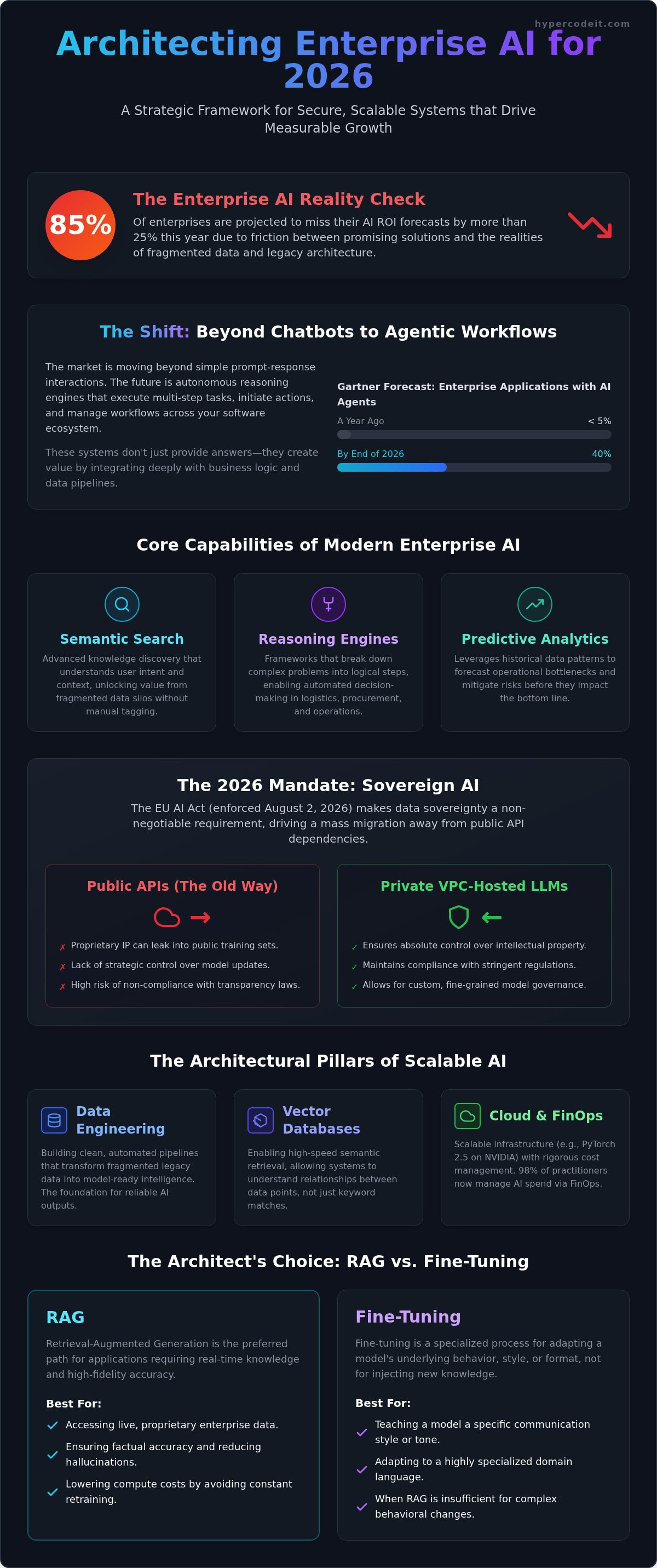
Retrieval-Augmented Generation, commonly called RAG, can be valuable when an AI application needs to answer questions or generate responses using an organization's own information.
Instead of expecting the model to contain all relevant organizational knowledge, a RAG system retrieves relevant information from an approved knowledge source and provides that context to the model.
Potential enterprise applications include:
- Internal knowledge assistants
- Policy and procedure search
- Technical documentation assistants
- Customer-support knowledge systems
- Research assistants
- Document analysis workflows
However, RAG should not be treated as a universal solution. Retrieval quality, document processing, permissions, evaluation, and source quality all influence the reliability of the final application.
When AI Agents May Be Appropriate
AI agents can be useful when a workflow requires more than generating an answer.
An agentic system may interact with approved tools or applications to perform a sequence of tasks—for example, retrieving information, applying business rules, updating a system, or requesting human approval.
This introduces additional operational and security considerations.
Organizations should clearly define:
- Which tools an agent can access
- Which actions it is allowed to perform
- What data it can retrieve
- When human approval is required
- How actions are logged
- What happens when the system fails or encounters uncertainty
Enterprise AI architecture should increase control as system autonomy increases.
Step 4: Build Security and Governance Into the Architecture
Security should be part of enterprise AI design from the beginning.
AI applications may interact with confidential business information, customer data, employee information, proprietary documents, internal databases, and operational systems.
Organizations therefore need controls around both data access and system actions.
Important areas can include:
Identity and Access Management
The AI application should respect existing authorization boundaries.
An employee should not gain access to information through an AI interface that they would not normally be permitted to access.
Data Protection
Sensitive information should be identified and handled according to organizational requirements.
Depending on the use case, this can involve encryption, masking, filtering, retention policies, or other controls.
Logging and Observability
Organizations should be able to understand how an AI application is being used and investigate unexpected behavior.
Logging can help teams monitor system actions, errors, retrieval behavior, performance, and security events.
Human Oversight
High-impact decisions should not automatically be delegated to AI merely because automation is technically possible.
Human review, approval, escalation, and exception-handling mechanisms should be designed according to the risk of the use case.
AI Evaluation
Testing should continue after the initial prototype.
Teams should evaluate the system against representative scenarios and monitor whether quality changes as models, data, prompts, workflows, and integrations evolve.
Step 5: Decide Whether to Build, Buy, or Combine
Enterprise AI strategy frequently involves a build vs. buy decision.
In practice, many organizations will use a hybrid approach.
Buying May Make Sense When:
- The business problem is common and standardized
- A mature product already addresses the requirement
- Customization requirements are limited
- Fast implementation is important
- The platform meets security and integration requirements
Custom Development May Make Sense When:
- The workflow is unique to the organization
- AI must integrate deeply with proprietary systems
- The organization has specialized business rules
- Existing platforms cannot support required data or workflows
- Greater architectural control is important
- The solution represents strategically valuable intellectual property
A Hybrid Architecture
Organizations do not necessarily need to build foundational AI models themselves.
A custom enterprise application can combine commercial or open model capabilities with proprietary data, business logic, APIs, security controls, user interfaces, and workflow orchestration.
This allows organizations to focus custom engineering effort on the components that create differentiation.
Step 6: Launch a Focused AI Pilot
Moving directly from an idea to an enterprise-wide deployment creates unnecessary risk.
A better approach is to define a focused pilot around one measurable business problem.
The pilot should answer several questions:
Does the technology work for the intended use case?
Can it operate with the organization's actual data?
Can it integrate with the required systems?
Will employees use it?
Can quality be measured?
Can the solution operate within the organization's security requirements?
A pilot should have success criteria before development begins.
For example, a knowledge assistant might be evaluated on retrieval relevance, response quality, user adoption, response time, and escalation frequency.
The objective is not simply to demonstrate AI.
The objective is to gather enough evidence to make a responsible decision about production deployment.
Step 7: Integrate AI With Existing Enterprise Systems
Many useful enterprise AI applications need to work with existing technology rather than operate as isolated chat interfaces.
That can require integration with:
- ERP systems
- CRM platforms
- Data warehouses
- Document repositories
- Customer portals
- Internal applications
- Workflow systems
- Cloud infrastructure
- Business intelligence platforms
APIs and middleware can provide controlled interfaces between AI applications and existing systems.
Legacy applications may require additional modernization before they can safely support real-time AI workflows.
This is where enterprise AI strategy and software modernization strategy intersect.
Organizations should evaluate integration requirements early instead of discovering them after the AI prototype has already been developed.
Step 8: Define How AI Success Will Be Measured
An enterprise AI project should have measurable objectives.
The right metrics depend on the business problem.
Potential measurements include:
- Process completion time
- Employee time saved
- User adoption
- Customer response time
- Retrieval accuracy
- Task completion rate
- Error or exception rate
- Operational cost
- Conversion rate
- Revenue influenced
- System availability
- Escalation frequency
Technical AI metrics are important, but executives also need business metrics.
A model can perform well technically while failing to improve the process it was designed to support.
For that reason, enterprise AI measurement should connect system performance to business performance.
Step 9: Prepare for Production and Scale
A successful pilot is only the beginning.
Production AI systems require ongoing engineering and operational management.
Before scaling, organizations should consider:
- Production infrastructure
- Access management
- Monitoring
- Cost controls
- Model and prompt changes
- Data updates
- Evaluation processes
- Incident response
- User training
- Documentation
- Support ownership
- Business continuity
Teams should also decide who owns the AI system after launch.
Clear ownership across business, engineering, data, security, and operations teams helps prevent a successful prototype from becoming an unsupported production application.
A Practical Enterprise AI Roadmap
A practical enterprise AI implementation can be organized into eight stages:
Phase 1: Business Discovery
Identify operational problems, stakeholders, desired outcomes, and candidate AI use cases.
Phase 2: Readiness Assessment
Evaluate data, infrastructure, integrations, security requirements, and organizational capabilities.
Phase 3: Use-Case Prioritization
Rank opportunities based on business value, feasibility, data readiness, and risk.
Phase 4: Architecture and Governance
Design the model, data, retrieval, integration, security, monitoring, and human-oversight architecture.
Phase 5: Pilot Development
Build a focused solution around a defined business problem and measurable acceptance criteria.
Phase 6: Validation
Test accuracy, security, reliability, usability, integration behavior, and business impact.
Phase 7: Production Integration
Connect the solution with enterprise systems and establish production monitoring and support.
Phase 8: Scale and Improve
Expand successful applications while continuously evaluating performance, cost, security, and business outcomes.
This roadmap prevents AI strategy from becoming disconnected from enterprise architecture and operational reality.
Common Enterprise AI Strategy Mistakes
Starting With the Technology
“Let's implement generative AI” is not a complete business objective.
Start with a problem and determine whether AI is the appropriate solution.
Ignoring Data Readiness
AI cannot reliably compensate for inaccessible, outdated, poorly governed, or low-quality enterprise information.
Building a Pilot With No Production Plan
A prototype may work perfectly in isolation but fail when security, integration, scale, and operational requirements are introduced.
Automating Too Much Too Soon
Increasing AI autonomy also increases the importance of permissions, monitoring, evaluation, and human oversight.
Measuring Activity Instead of Value
Number of prompts, users, or AI features does not necessarily demonstrate business value.
Connect AI metrics to operational and financial outcomes.
How HyperCode Supports Enterprise AI Initiatives
Enterprise AI often requires expertise beyond model selection.
Organizations may need to connect AI strategy with custom software development, existing applications, data infrastructure, cloud environments, APIs, security controls, and analytics.
HyperCode provides technology consulting and engineering capabilities across AI, custom software, cloud, data, and enterprise technology services.
For organizations exploring AI initiatives, the engagement can begin by identifying business requirements and assessing the technical environment before selecting an implementation architecture.
This helps create a roadmap connecting the AI use case to the systems, data, security controls, and engineering capabilities required to operate it.
Enterprise AI Strategy Checklist
Before moving an AI initiative toward production, technology leaders should be able to answer:
- What specific business problem are we solving?
- Who owns the business outcome?
- How will success be measured?
- What data does the AI system require?
- Is that data accurate and accessible?
- Which systems need to be integrated?
- What information is sensitive?
- Who should be allowed to access the system?
- What actions can the AI perform?
- Where is human approval required?
- How will quality be evaluated?
- How will system behavior be monitored?
- What happens when the AI fails?
- Who will maintain the system after deployment?
- What evidence would justify scaling the solution?
If these questions cannot yet be answered, the organization may need further discovery before making a large implementation commitment.
Frequently Asked Questions
What is an enterprise AI strategy?
An enterprise AI strategy is a structured approach for identifying where AI can create business value and determining the data, technology, governance, people, integrations, and measurements required to implement it successfully.
How should a company start an enterprise AI initiative?
Start with a clearly defined business problem. Evaluate potential use cases based on expected value, technical feasibility, data readiness, and risk. A focused pilot can then be used to validate assumptions before a larger rollout.
Should enterprises build or buy AI solutions?
It depends on the use case. Standardized requirements may be addressed effectively by existing platforms, while specialized workflows, proprietary integrations, or strategically important systems may justify custom development. Many organizations use a hybrid approach.
Can enterprise AI integrate with legacy systems?
Yes, but the difficulty depends on the architecture of the existing system. APIs, middleware, data pipelines, and selective application modernization can provide controlled ways for AI applications to interact with legacy environments.
What is RAG in enterprise AI?
Retrieval-Augmented Generation is an architecture in which relevant information is retrieved from an external knowledge source and supplied to a generative model as context. It can be useful for enterprise applications that need to work with organization-specific information.
How do you measure enterprise AI ROI?
Measurement should be connected to the business process being improved. Depending on the use case, organizations may evaluate time saved, process efficiency, adoption, accuracy, operating cost, customer experience, conversion, or revenue influence alongside technical performance.
How long does it take to implement an enterprise AI solution?
There is no universal implementation timeline. The duration depends on the use case, data readiness, integration complexity, security requirements, architecture, testing requirements, and organizational approval processes. A readiness assessment and scoped pilot can provide a more defensible estimate.
Build an Enterprise AI Roadmap Around Your Business
A sustainable enterprise AI strategy is not defined by how many AI tools an organization adopts.
It is defined by how effectively AI is connected to business objectives, reliable data, secure architecture, existing systems, measurable outcomes, and responsible operational processes.
Organizations that start with clearly defined problems can make better decisions about where AI belongs, which architecture is appropriate, what should be automated, and where human judgment remains essential.
For enterprises evaluating AI opportunities, the first step is often not building a model—it is creating the right roadmap.
HyperCode can help your organization assess AI opportunities, define an implementation roadmap, and connect AI initiatives with the software, data, cloud, and integration capabilities required for production.